The United States Senate passed S.4035, the DEATH BETS Act, by voice vote on November 20, 2026, moving the first prediction-market legislation to the House while Oregon considers an 8% tax and New Jersey a 9% surtax. The bill amends the Commodity Exchange Act to prohibit CFTC-regulated entities from offering contracts reasonably expected to settle mainly on an individual death, and it gives the Commodity Futures Trading Commission authority to designate additional comparable activities by rule. House passage and presidential action are still required, so no operator or state tax model is final.
What S.4035 would restrict
The bill was introduced in March by Senators Adam Schiff and John Curtis. It bans contracts if, at listing time, they are reasonably expected to settle mainly on an individual death. The CFTC gains rulemaking authority to designate additional comparable activities, so the statute's final scope depends on future agency action, not just the text. The Senate voice vote made S.4035 the first prediction-market bill to pass either chamber, but Fortune reported that the House has not voted and no presidential action has been taken.
State revenue models
Oregon: modeling on North Carolina
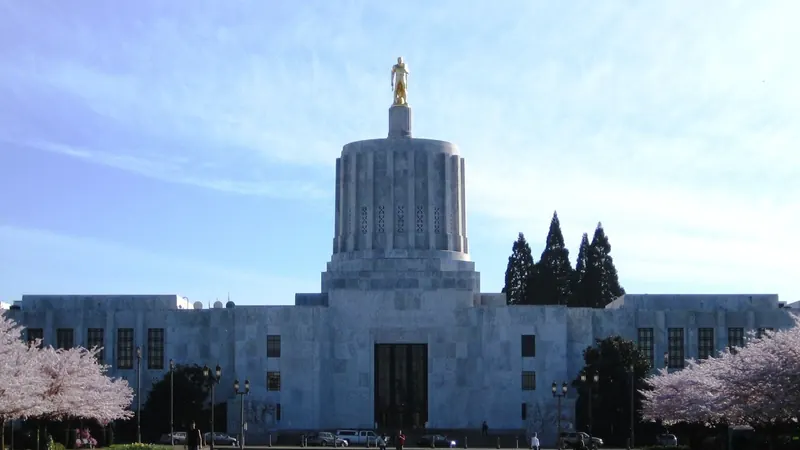
Oregon Senate Majority Leader Anthony Broadman and Representative Lisa Fragala want a state cut of prediction market profits. Broadman said the proposal is modeled on North Carolina's 6% tax on net revenues starting Jan. 1, and he is likely to push an 8% rate for Oregon. The stated use is wildfire costs. Broadman told NPR for Oregonians: "This is an emerging economic activity. I would argue it’s not adequately contributing to the state’s growth." The revenue arithmetic is thin: North Carolina projects nearly $12 million in annual tax revenue by 2031 under 6%, Oregon's lottery gets 51% of DraftKings net sports betting revenues and expects nearly $89 million in the current budget cycle, but the $2.5 million wagered on an Oregon governor prediction market is a handle figure, not net revenue. No Oregon prediction market revenue projection is confirmed.
New Jersey: tax and license
New Jersey bill A5336 would impose a 9% surtax on prediction market income; A4689 would require prediction markets to get a state sports gambling license. Assembly Member Balvir Singh told NJ Spotlight News: "Certain markets, I don’t believe, that New Jersey’s values align with what they’re selling." Singh also said gambling is the state's space, not federal. State lawmakers in 14 states have proposed 50 prediction-market bills, so these proposals are part of a wider attempt to capture fees.
Federal preemption question
Kalshi spokesperson Jacki McGavick said: "We comply with all corporate tax laws and believe in responsible state taxation, even as a federally regulated derivatives exchange." Kalshi also argues it cannot be governed like other gambling because its contracts are financial instruments. Polymarket says prediction markets are CFTC-regulated under a federal framework, not state rules. Federal appeals courts have split on state regulation; in August the 9th Circuit ruled sports prediction markets could be regulated like gambling. Broadman said: "I fully expect that the U.S. Supreme Court is going to take this up, but that’s not a reason to slow us down." The DEATH BETS Act does not contain an explicit state tax preemption clause, but it would place these contracts under federal prohibition and CFTC designation. Whether that reclassification displaces Oregon's proposed 6% to 8% tax or New Jersey's 9% surtax and licensing requirement is not known.
Timeline and open questions
- March: Senators Schiff and Curtis introduced S.4035.
- August: The 9th Circuit ruled sports prediction markets could be regulated like gambling.
- November 20, 2026: The Senate passed S.4035 by voice vote, sending it to the House.
- Jan. 1: North Carolina's 6% prediction market tax takes effect.
- Jan. 19: Oregon legislative session begins.
Not yet confirmed: - whether the DEATH BETS Act will pass the House and be signed; - whether federal regulation would preempt state taxation or revenue-sharing; - whether the Supreme Court will take up the state authority question; - whether Oregon will adopt 6%, 8% or another rate; - how much revenue Oregon could generate; - whether Kalshi's federal derivatives exchange status prevents state taxation.
Anyone struggling with gambling can call 1-800-GAMBLER for free and confidential support.